 November 4, 2026
 by Harry Fisch
Expedition Report · Mongolia · 2026
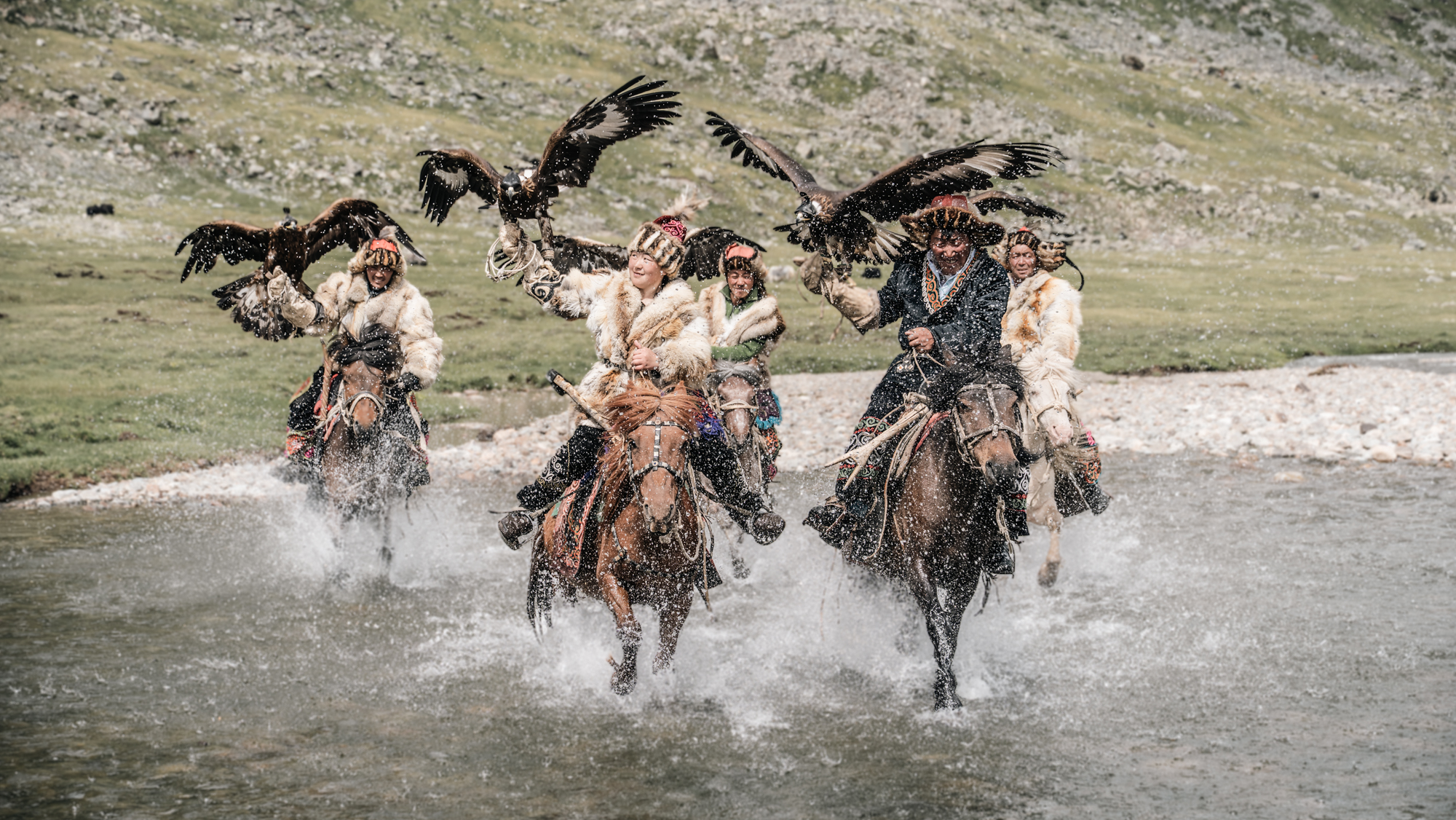
In July 2026, on a journey we have made at least once a year for the past decade, our small group flew to Mongolia’s far west to share the gers of Kazakh eagle hunters, then crossed the country to watch a small-town Naadam beside the Orkhon River. 
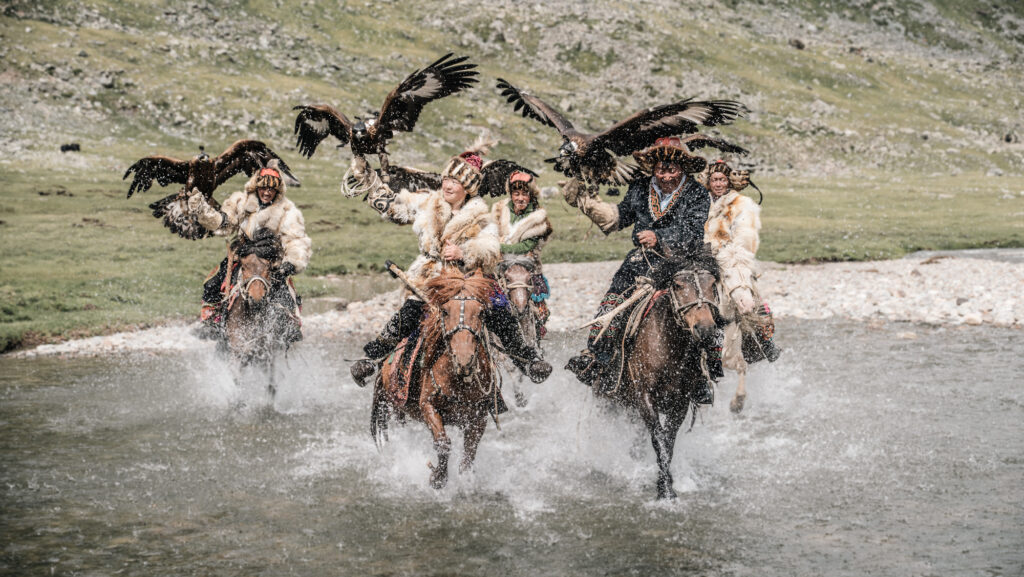
Kazakh eagle hunters ford a river, wings wide open · Bayan-Ölgii
Ulaanbaatar
Some places you photograph; others you have to earn. We have been coming back to Mongolia at least once a year for the last ten years, and every time I find myself longing for the same moment: sitting inside a Kazakh ger (the felt tent of the steppe), a cup of tea warming my hands, while a golden eagle shifts its weight on a perch barely a metre away. In July 2026, with our small group of photographers, that moment came round again — but first, the capital.
We were met at the airport in Ulaanbaatar (the name means ‘Red Hero’) and, barely checked in, were out on the streets. The city is a wonderfully odd collage of then and now: glass towers and gleaming 4x4s elbowing up against the drab, uniform blocks left behind by the Soviet era. We roamed the main sights and the back alleys before heading to the Choijin Lama Temple, a sprawling complex closed during the purges of the late 1930s and later turned into a museum. Among its painted eaves we held our first set session, with two models in traditional Mongolian dress — silk, brocade and sculpted headdresses glowing against the faded timber. A gentle warm-up. Mongolia was only clearing its throat.
Bayan-Ölgii
The next morning we flew west, nearly 1,300 km (800 miles), to Ölgii, the capital of Bayan-Ölgii, Mongolia’s westernmost province. Here the Kazakhs, a nationally recognised minority, make up the great majority, and they have guarded their language, their embroidery and their customs with remarkable care.
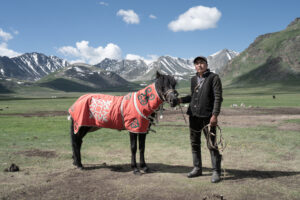
A Kazakh horseman and his horse beneath snow-capped peaks · Bayan-Ölgii
We spent the first hours loosely, cameras up, exploring the town, then moved on to posed sessions with local people before driving out towards our hosts. We stopped whenever the landscape demanded it — which was often. Mountains rose sharp and hard against a sky of almost absurd clarity, and beyond them the country simply rolled away, mile after empty mile. That night we slept in large individual gers with the Kazakh family who would host us for the days to come. (Yes, we brought our own portable eco-toilets. Romance has its limits.)
The Eagle Hunters
And then, the eagles. Up close, a golden eagle (Aquila chrysaetos) is less a bird than a presence: a wingspan that can reach 2.2 metres (7ft 3in), talons built for foxes, and a stare that makes you straighten your back. The hunters, the kusbegi (eagle masters), learn their trade from father to son, and they do not discuss the training or the bonding with outsiders. So, over that first afternoon and the two full days that followed, the family who had run their training for generations showed us instead — how the birds are handled, flown and called back to the glove, and how they are used to hunt.
Among them was a multi-time champion of the Golden Eagle Festival, a man whose quiet authority was matched only by his bird’s. The bond between them is astonishing. He can feed his eagle by hand; anyone else, I was warned, risks being bitten, or worse. I kept my fingers firmly in my pockets. The eagle, for its part, looked at me as if to say, ‘Wise choice.’ Incredible.
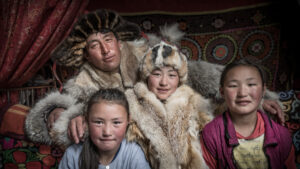
An eagle hunter and his children at home in their ger · Bayan-Ölgii
Back to the Capital
Inside the ger the light was a portrait photographer’s dream: soft, warm, falling across fox-fur hats and the dense, swirling embroidery of the tus kiiz (Kazakh wall hangings) that every family treasures. Portraits there needed no direction at all, only patience and respect. We gave our final morning to the eagle hunters, then drove back to Ölgii town in the afternoon for a comfortable night in a four-star hotel.
The following day we flew back to Ulaanbaatar, checked in, and went straight to Gandan Monastery, the beating heart of Mongolian Buddhism, whose great hall shelters a gilded statue of the bodhisattva Migjid Janraisig (Avalokiteshvara) some 26 metres (85ft) tall. In the afternoon we settled in for a traditional cultural performance, one of the most authentic in the city. Beautiful.
Into the Steppe
After breakfast the real countryside adventure began. We drove to Elsen Tasarkhai, a ribbon of sand dunes laid across green mountain steppe, and arrived in time for lunch at a ger camp. Then came a visit to a camel-herding family and their Bactrian camels, out on the sand. We photographed the herders at work and the show they put on with their animals before continuing to Kharkhorin, where the evening closed with another traditional performance and a night in our individual gers.
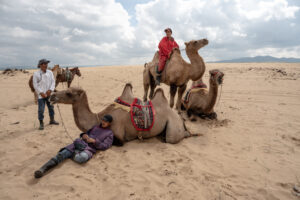
Camel herders and their Bactrian camels on the dunes · Elsen Tasarkhai
Naadam
Naadam (literally ‘games’) is Mongolia’s great summer festival, built around the ‘three manly games’ of wrestling, horse racing and archery. In Ulaanbaatar most of it happens inside a giant stadium — crowded, mass-market and hard to reach. We had chosen instead the Naadam of Kharkhorin, a small town set in a wide valley on the banks of the Orkhon River, and we arrived in the morning to photograph the opening ceremony. What followed was a feast. Horses thundered across the steppe; wrestlers in their tiny embroidered vests circled and grappled in the dust; archers loosed arrows into a vast blue sky while we stood close enough to hear the bowstrings sing. Because the festival takes place in a small town, we also had access to the local schools and official buildings, and we spent hours among the competitors and the happy chaos that follows every event: proud Mongolians in their finest deel (the traditional long robe), showing off medals and beautiful horses. And the food! Our hosts shared their famous huushuur (fried meat pies), hot, crisp and quite delicious — Mongolian hospitality in its most portable form.
Erdene Zuu
We rose early for the second day of Naadam and, after breakfast, drove to Erdene Zuu, the ‘Hundred Treasures’ monastery. Founded in 1585, it is more than four hundred years old and was built in part from the bricks of ancient Karakorum, the capital of the Mongol Empire that once stood on this very ground. Its long white wall, crowned with stupas, sits in the distinctly modern bustle of today’s Kharkhorin — a contrast that kept our shutters busy. In the active temple section, monks were still chanting through curling incense smoke. Goosebumps.
Then it was back to the festival for more events and, at last, the phenomenal closing ceremony.
The Horse Tamers
We bid Kharkhorin a fond farewell and headed north into the wilds, to the encampment of a nomad family. Here we spent the day with the horse tamers, watching them weave around the wild geldings in their care and bring them, rein by rein, under control. Dust, sweat, flying manes — and a quiet, patient skill that has nothing to do with brute force. Between sessions we made portraits of the family as they went about their daily lives alongside their ever-present animals.
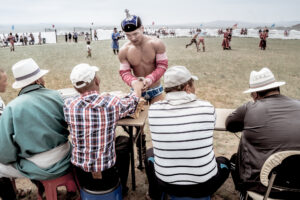
A wrestler greets the judges at the Naadam ground · Kharkhorin
Early the next morning we drove back to Ulaanbaatar, arriving by lunchtime, and gave the afternoon to a private session with a shaman — a final, intense encounter with Mongolia’s older spiritual world. The following day we were transferred to the airport, twelve days after we had first landed.
Coda
What stays with me is not one picture but the space around all of them: the sky over Bayan-Ölgii, the hush inside a Kazakh ger, the roar of a small-town Naadam. Mongolia gave us eagles and horsemen, monks and herders, tamers and a shaman — and, above all, people who opened their homes to a group of strangers with cameras. I left with full memory cards and an even fuller heart. Mongolia, thank you.
Words: Harry Fisch Travel Photographer · Nomad Photo Expeditions
Sony World Photography Awards and PhotoEspaña finalist; Prix de la Photographie de Paris Gold winner; LensCulture Critics’ Choice winner; exhibitions at Photo London, Chicago, Seattle and Madrid. Prince and Minister of the Kingdom of Angolin, Benin.